ELI5 Hartree Fock Theory
The wave function
Wave function \(\Psi(\vec{r}_1, \vec{r}_2, ..., \vec{r}_N)\), abbreviated \(\Psi(\vec{r})\) from now on,
describes
the quantum state of a molecular
system.
- It contains information about electrons and their distribution in space.
- \(|\Psi(\vec{r})|^2\) describes the probability density of a complete electron configuration.
- One electron density for probability of finding an electron at a certain point:
\(\rho(\vec{r}) = N
\int
|
\Psi(\vec{r}, \vec{r_2}, ..., \vec{r_N}) d\vec{r_2}, ...,
d\vec{r_N}\)
The Hamilton Operator
Hamilton Operator \(\hat{H}\) describes energy contributions on molecular system.
- Kinetic energy of electrons (kinetic energy of nuclei ignored in Born-Oppenheimer approximation).
- Electron-electron repulsion.
- Electron-nuclear attraction.
Nuclear-nuclear repulsion for fixed nuclei is a constant in the BO approximation and not included in the
(electronic) Hamiltonian.
The Hartree Fock energy
Energy of the molecular system is calculated by evaluating the wave function with the Hamilton Operator
\(\hat{H}\Psi = E\Psi\).
For a general trial wave function, the expected
energy is calculated by \(E[\Psi] = \frac{\langle \Psi \mid \hat{H} \mid \Psi \rangle}{\langle \Psi \mid
\Psi\rangle}\).
Energy minimization \(E_0 = \min_{\Psi} E[\Psi]\) is done using the variational principle:
The variational principle (SO Ch. 2)
It states that the energy calculated by a trial wave function is always greater or equal to the true
ground-state energy \(E[\Psi] \geq E_0\).
The goal is to find the wave function to minimize the energy:
\[
E_0 = \underset{min}{\Psi}\frac{\langle \Psi \mid \hat{H} \mid \Psi \rangle}{\langle \Psi \mid \Psi
\rangle}
\]
In simple terms, we are trying to find the lowest point in a landscape that's defined by the wave function
parameters.
The Hartree-Fock approximation
HF approximates the molecular wave function as a single Slater determinant that is constructed from
molecular
orbitals.
This approximates the influence of all other electrons on one electron (the electron-electron correlation)
with an average field, Hartree-Fock is therefore a mean-field theory.
The procedure is then to find optimal molecular orbital coefficients that minimize the energy.
- Initial guess for molecular orbital coefficients and density.
- Construct Fock matrix from current density and mo coefficients.
- Calculate energy (Contraction of Fock Matrix with density -> electronic energy).
- Improve orbital coefficients to lower energy (Diagonalization of Fock Matrix using Roothaan-Hall
equations
-> new coefficients).
- repeat until convergence criteria are met (often difference in energy and density per iteration).
- Calculation of properties (dipole moments, ...).
Mathematical foundation
Atomic orbitals
Molecular orbitals
Fock operator
Roothaan-Hall equations
Density matrix
One- and two-electron integrals
Evaluating atomic orbital integrals
Gaussian-type orbitals
Gaussian product theorem
Overlap integrals
Kinetic energy integrals
Electron-nuclear attraction integrals
Electron-electron repulsion integrals
Obara–Saika recurrence scheme (OS paper)
Implementation
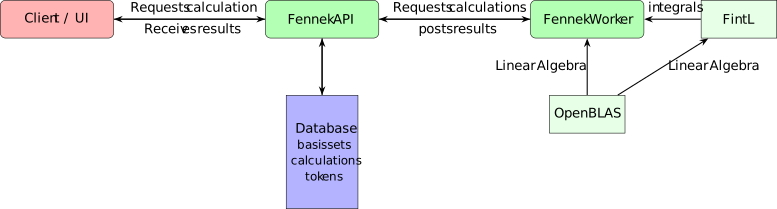
Fintl - Fortran molecular Integral Library
A molecular integral kernel using contracted GTO written in Fortran with a C interface and an included python
API wrapper.
Source code under fintl repository
Basis set representation
Fintl and the SCF worker use a shell-based basis format.
A shell is a contracted GTO.
In Fennek, a Shell is defined as:
ContractedGTO(Integer L, List<PrimitiveGTO> primitives)
where
PrimitiveGTO(double exponent, double coefficient)
In Fintl a shell is defined as:
                type :: shell_t

                real(dp) :: center(3)

                integer :: L !(S: 0, P: 1, D: 2, ...)

                integer :: n_prim !number primitives

                integer :: n_cart !number cartesians

                real(dp),allocatable :: expo(:), coeff(:), norm_coeff(:,:)

                end type shell_t
The compatibility layer uses AOShell from the worker as
                AOShell(Integer L, Integer nPrim, Integer nCart, Coordinate center, List<Double> coefficients,
                List<Double> exponent)
and a parser into the fintl shell lists. Since all primitives in one shell have the same L, all have the
same number of cartesians.
SCF worker
Matrix operations and diagonalization
Single atom density guess
Convergence acceleration (DIIS, damping)
Fermi smearing
Testing and validation
Correlated methods
Limitations of Hartree-Fock
Electron correlation
Configuaration Interaction
Møller-Plesset perturbation theory
Coupled Cluster (CCSD/CC2)